Before the Playlist: How the Mixtape Became a Listening Gesture
Mixtapes turned song selection and order into a personal gift. See how cassette limits, sequencing, and a handwritten sleeve shaped a listener’s experience.
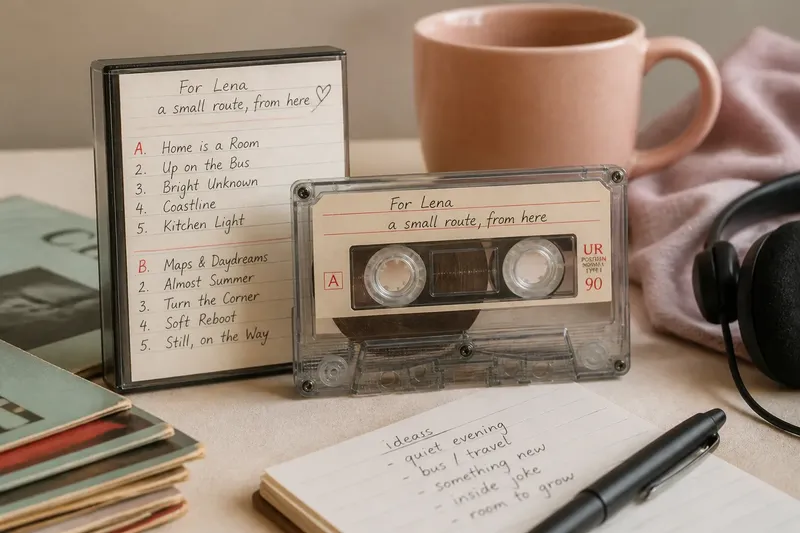
A handwritten cassette label can turn a stack of songs into a message before the listener presses play. A mixtape made that message through selection and order, shaping a personal route through music for someone else.
The cassette became the familiar emblem of the mixtape because it was portable, recordable, and easy to give. But the impulse was never limited to tape: people made collections on records, open-reel tape, compact discs, and digital playlists. The cassette’s capacity and two sides simply made its choices especially visible.
A mixtape began with a listener in mind
Imagine a clearly invented situation: Maya wants to share music with her friend Lena, who is leaving their shared apartment for a new city. Lena has said she misses home, but Maya knows a set of hometown anthems would feel too obvious. She wants a collection that starts with familiar comfort and gradually opens toward curiosity.
Maya’s first question is not “Which songs belong together?” but “What do I want Lena to experience?” A mixtape might follow a mood, a memory, a private joke, a discovery, or an imagined journey. It need not display impeccable taste. It needs to make sense as an offering to one person.
The maker listens on two levels: to each song, and to its possible meaning for the recipient. A track may recall a kitchen conversation, say something the maker cannot, or introduce a sound the listener might welcome. That attention is what separates a mixtape from a pile of favorites.
Selection made taste visible
In Maya’s invented process, she writes a loose list of candidates before recording anything. One song recalls a quiet evening at home. Another carries the restless energy of travel. A third is new to Lena, chosen because its bright arrangement might appeal to her. Maya leaves off a beloved but gloomy track: it belongs more to her own mood than to the message she wants to send.
Editing means deciding what to leave out as well as what to include. An omission can keep the collection focused, make room for contrast, or spare the listener a private reference that would mean little to them. The result is an interpretation of music, not a neutral container for it.
In periods when copying and recording took more deliberate effort than adding a song to a digital queue, that work could be felt by the recipient. But effort alone did not make a tape meaningful. Attention did: which songs, for this person, in this moment?
Sequence turned songs into a small argument
Maya puts the familiar song first, so Lena can settle in. The second is more buoyant. Later, Maya places the unfamiliar discovery after a song Lena already loves, giving it a musical neighbor rather than dropping it into the sequence without context. She chooses a quieter closing track, but not a bleak one; she wants the tape to leave room for what comes next.
Sequence can make songs seem to speak to one another. A brisk track after a slow one may feel like a release; two songs with similar textures can create a pocket of calm. A sharp shift can be meaningful, playful, or distracting. There is no single correct arc. The maker composes a listening path from pieces that were not necessarily created as one work.
For a cassette, the two sides added a physical hinge. The first side could feel like an opening movement, while turning the tape offered a pause before the next stretch. Some makers treated the flip as a deliberate midpoint; others simply filled the available space. A playlist or disc can create flow differently, without that same built-in pause.
Say Maya notices that her invented first draft ends side one with a loud, triumphant song, while side two opens with a hushed, intimate one. She moves a quieter song to close the first side instead. The intended observable result is a gentler transition across the pause: Lena can turn the tape over without feeling that the emotional thread has snapped.
The recording surface shaped the handoff
To make the cassette, Maya would need a blank tape, a working cassette deck, and a source for the songs, such as records, CDs, or other tapes. She would have to manage recording levels and pauses, avoid recording over material she meant to keep, and fit the program to the tape’s capacity. Those constraints could influence her selection, but they would not dictate one artistic solution.
Recording also meant translating music from its original settings into a new sequence. The listener heard that sequence through the cassette’s sound and operation. There might be a little hiss or a change in level between sources. Some listeners valued those traces as signs of a handmade object; others treated them as ordinary features of the medium.
Maya writes a plain label with Lena’s name and a short title. She might add track names and sides, enough to help Lena find a song without turning the sleeve into an essay. Handwriting, paper, and a few chosen words make the object legible as a gift, while leaving space for the listener to discover the sequence for herself.
Not every detail deserves an afternoon of fussing. Matching ink colors or finding elaborate decorative paper would do less than checking that the tape plays and that its order feels coherent. A modest sleeve can carry a precise thought; elaborate packaging cannot supply one that is missing.
A mixtape could travel in more than one format
The cassette is central to the familiar image of the mixtape, but it is not the only way to make one. A collection of records selected for a friend can carry the same curatorial impulse, even if the listener must change discs. A burned compact disc can preserve a sequence in a case. A shared playlist can be edited, replayed, and sent across distance with little physical burden.
Each form changes the experience. A cassette makes a sequence feel fixed and gives the listener a tangible object, while a digital playlist can be revised after it is shared. A record collection offers the pleasure of physical selection but may involve interruptions between sides. These are different ways of listening and giving, not a ladder on which one medium automatically outranks the others.
In Maya’s imagined outcome, Lena receives the cassette, reads the label, and listens on a player in her new room. She recognizes the opener, pauses at the unfamiliar song, then continues because the sequence has made a quiet invitation. The tape does not resolve the distance between friends. It gives Lena a crafted way to hear Maya’s attention inside a run of music.
What makes a mixtape feel personal?
Does a mixtape have to use a cassette?
No. The cassette is a memorable form, but the gesture can take shape on a disc, in a set of records, or in a digital playlist. What matters is that the selection and order are made for a listener rather than assembled without a point of view.
Should the songs share one mood?
They can, but a single mood is not required. Contrast may create movement, and a surprise can keep a sequence from feeling predictable. The useful question is whether the shifts seem intentional to the maker.
How many songs belong on a mixtape?
There is no universal count. A cassette’s capacity, a disc’s format, or a playlist’s intended listening occasion may shape its length. A shorter, focused collection can say more than a long one that loses its thread.
Should the maker explain every choice?
Not necessarily. A title or a few track names can orient the listener while leaving the music to carry much of the meaning. A note may help when a reference is especially personal, but an explanation need not accompany every song.
The gesture survives when the format changes
Maya’s invented tape shows how a mixtape can turn three ordinary decisions into communication: whom to address, what to include, and how to place one song beside another. The cassette made those decisions visible in a physical object, but the idea was never locked inside plastic tape. It was the act of shaping someone else’s listening with care.
That is why the mixtape remains a useful way to think about sharing music. Before choosing a format, a maker can ask what the recipient might recognize, where a fresh discovery could fit, and what kind of ending would leave the right space. A mixtape made song order feel personal; that listening gesture can still travel through whatever form best suits the people involved.