The Myth of the Perfect Listening Volume
Perfect listening volume depends on the recording, room, and moment. Choose a comfortable level that reveals musical detail without mistaking loudness for clarity.
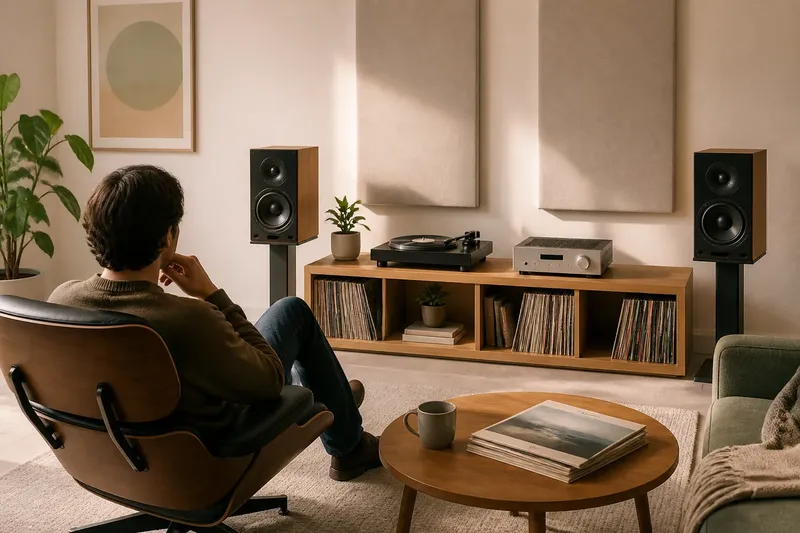
You turn up a quiet folk recording until the singer feels present, then the next track arrives with a sharp snare and suddenly the room feels too loud. That shift is why perfect listening volume has no single setting: the right level depends on the recording, the playback system, the room, and what you need to hear.
A louder playback can make bass, transients, and voices seem more vivid. But vividness is not the same as detail. A useful level lets you follow the performance without bracing for peaks, leaning toward the speakers, or straining to catch quiet passages. Choose for the listening situation, not for a number on a dial.
Choose a level for the moment, not the album
Start with the task in front of you. Are you listening closely to a mix, sharing music while talking, or keeping a record company while you work? Each calls for a different balance between presence and ease.
- For focused listening: Set a comfortable level at which vocals and instruments remain clear, then leave room for sudden accents. If you find yourself anticipating a loud chorus with tension, turn it down.
- For background music: Keep the sound below the level of ordinary conversation. The music should add texture without making you raise your voice or repeatedly adjust your attention.
- For a shared room: Ask the people nearby what feels comfortable and account for where they sit. A setting that sounds gentle beside the speaker may be intrusive across the room.
- For late-night listening: Use a lower level and consider headphones if the sound would carry into another room. Keep enough clarity to follow the music without compensating by turning it up.
These are starting points, not rules. A sparse acoustic track and a dense electronic mix can feel very different at the same setting. Let comfort guide the decision, then adjust for the music you actually hear.
Separate loudness from detail
Turning up the volume often makes a mix seem fuller. Quiet guitar harmonics become easier to notice, the kick feels more substantial, and a voice may seem closer. That change does not necessarily mean the playback has revealed information that was missing. Louder sound can simply make existing details more noticeable to your ears.
This is where comparisons become misleading. If you switch between two tracks and one is mastered louder, it may seem more energetic or polished even when the quieter track contains equally clear playing and production. The same effect can happen when you turn up a single song to inspect a subtle detail: everything rises together, including the parts that can become tiring.
For a fair comparison, bring the louder track down rather than pushing the quieter one up. Then listen for the actual feature you care about: the consonants in a vocal, the decay of a cymbal, or the separation between instruments. If you still cannot hear it at a comfortable level, check your speaker placement, headphone fit, or listening position before assuming more volume is the answer.
Let the recording and room set the limits
Recordings vary in average level, dynamic range, and arrangement. A track with a soft opening and a forceful refrain needs space for that contrast. A heavily compressed track may stay consistently loud, leaving less of a quiet-to-loud transition. Neither type has a universal dial position that suits every listener and room.
Your room matters, too. A bare space with hard walls can make bright instruments feel sharp as reflections build up. Soft furnishings may absorb some of that reflected sound, while a small room can make bass seem stronger near a wall or corner. If a mix feels muddy or piercing, try changing your seat or speaker position before raising the level.
Headphones create their own considerations. A close, centered vocal may feel intimate even at a restrained setting, while open-back headphones can let outside sounds through. If background noise makes you keep turning the volume up, move to a quieter spot or use suitable noise isolation rather than competing with the noise.
What should you do in common listening situations?
How loud should music be for focused listening?
Use a level that lets you follow individual parts without discomfort. If you want to inspect a quiet detail, briefly focus on it, but do not treat maximum loudness as the route to precision.
Why does one song sound quieter than the next?
Tracks can differ in mastering level, density, and musical dynamics. Adjust between songs when needed, but avoid raising every quieter track until it matches the loudest one by sheer force.
Should I turn up music to hear more detail?
Not automatically. A modest increase may make a detail easier to notice, but if the sound becomes tense or tiring, lower it and try a different seat, headphone fit, or playback position.
How can I tell if the volume is too high?
Listen for discomfort, a need to raise your voice, or reluctance to keep listening through louder passages. After removing headphones, notice whether your ears feel strained; if they do, take a break and use a lower level next time.
Use a simple adjustment routine
When a recording feels wrong, make one change at a time. That keeps you from confusing a tonal or placement problem with a volume problem.
- Begin at a low, comfortable setting before playback.
- Raise it gradually until the main musical parts are easy to follow.
- Listen through a louder passage, not only the quiet opening.
- If the sound feels harsh or forceful, lower the level and listen again.
- If detail remains hard to follow, adjust your position or playback setup before increasing volume further.
Say you are listening to an invented recording with a quiet vocal and a bright drum fill. You start softly, raise the level until the words are clear, then hear the fill land sharply. Rather than turning up again to chase the vocal, you move closer to the speakers and angle them toward your seat. The expected result is a clearer vocal at a level that keeps the drum fill comfortable.
There is little value in chasing a precise dial position, matching a supposed studio reference, or repeatedly raising the level to make every track equally forceful. Those habits can distract from the music and do not account for differences in rooms, equipment, hearing, or arrangement.
Keep comfort ahead of the volume number
Perfect listening volume is a decision you make for a particular recording and moment. For close attention, aim for clarity without tension; for background listening, let conversation remain easy; for shared or late-night sessions, account for other people and nearby rooms. The right level can change from song to song, and the perfect listening volume is simply the one that lets you hear the music without making loudness itself the point.